Table of Contents.
- On the situation in Europe and the character of the EU
- Italy and the existing electoral options
- Let’s implement a proposal to overcome irrelevance
- On the situation in Europe and the character of the EU
- The elections for the European Parliament, to be held in Italy on June 8 and 9, 2024, take place against a backdrop of a serious deepening of the capitalist crisis and the military, political and economic competition among capitalist powers for supremacy in the international imperialist system. The worldwide tendency toward polarization into two opposing camps – at present, a Euro-Atlantic camp and a Euro-Asian camp – finds one of its potential fault lines precisely in Europe and within the EU itself, where growing contradictions are emerging between different factions of the bourgeoisie. Germany’s economic recession, strongly correlated with the context of the imperialist war in Ukraine, shows that the spiral of a new, further cycle of economic crisis on the European continent is a real possibility. In this context, with the clouds of war and crisis gathering and an attack on peoples’ rights continuing to be carried out, the utmost clarity must be put in place on the character and nature of the EU on the part of communists.
- The European Union is an imperialist alliance of big capital, controlled by monopolies, large economic conglomerates, and big finance, expressing at the European level the dictatorship of capital against peoples and workers. Thirty years of the EU’s history have shown that it has nothing to do with brotherhood among peoples, with internationalism, with the promises of progress, peace and prosperity that accompanied its birth. The European single market is not, and never could have been, the ground on which advancement of workers’ rights and living conditions is produced. On the contrary, it has shown that competition for profit always takes place on the shoulders of the exploited. It is a fact that after three decades, the level of purchasing power linked to real wages, employment and stable employment rates, wealth distribution, even the level of “democratic” freedoms, have sharply deteriorated in all EU countries. While the working class in all countries suffers from the anti-people policies of the EU and national governments, often imposed by means of EU directives and regulations; while more than 27 thousand refugees and immigrants have died in 10 years as a result of EU criminal policies; while police repression and reactionary involution increase, the capitalists benefit from an EU built to suit their needs, to the point that lobbying is openly institutionalized and recognized as a key part of “European democracy.” Meanwhile, anti-communism is adopted as the official ideology of the EU, through the anti-historical equating of communism and Nazism, and in many EU countries (Latvia, Lithuania, Poland, to name a few) communist parties are banned. As communists, we reiterate the class-based, reactionary and anti-grassroots character of the EU, as well as the unreformability of this alliance.We denounce the illusion of “democratizing” the EU through a reform of the role of its bodies, such as the European Parliament, which is being promoted today by political forces from across the bourgeois spectrum, from the liberal to the social democracies, old and new. We reaffirm the position we have expressed in our respective congresses and political theses: “If a Europe of the peoples can be born, it will only be from the ashes of the EU of the bosses and capital.”
- The illusion of the EU as the bringer of peace has definitely collapsed in the face of the evidence of the ongoing international imperialist confrontation, in which the EU plays a leading role. The EU is in the forefront of supporting the State of Israel, its genocidal plan and illegitimate occupation of the Palestinian territories. In February 2024, under the pretext of defending “freedom of navigation,” it launched the “Aspides” military operation in the Red Sea, effectively intervening in Saudi Arabia’s ongoing criminal war against Yemen and increasing the risk of wider escalation in the Middle East. The EU is co-responsible for the escalation of war in Ukraine, where a bloody imperialist war is now being fought between the US-EU-NATO bloc and capitalist Russia with its allies. This, not only because most EU countries are members of NATO, but also because they have been actively – and, to some extent, independently – cooperating with the Ukrainian regime for years. The EU has supplied the Zelensky regime with more than 143 billion euros since the beginning of the war, plus another 50 already prepared for the next year, taken from the pockets of workers and citizens; tons upon tons of weapons, with no qualms about supporting mercenary groups and neo-Nazi gangs like the Azov battalion, which have been guilty of horrendous crimes against the civilian population. For the first time in 70 years, Europe is really facing a war that may turn into a generalized conflict, with the threat of the use of nuclear weapons being waved by the belligerent forces.
In this context, the EU is by no means a factor for peace. It is worth mentioning that the European Commission has, on several occasions, explicitly appealed to the need to adapt to a “war economy” and that it is embarking on the path of building a “European army.”
The reasons for this conflict, on both sides, lie in the inter-capitalist competition for control of markets and market shares, territories, energy and mineral resources, trade and supply routes, etc. They lie, in other words, in capitalism itself; in the interests of big capital that underlie the very existence of the EU. The struggle for peace and brotherhood among peoples, against imperialism and war plans, is now more than ever also a struggle against the EU.
- The main policies promoted by the EU today confirm its anti-people character. The “Green New Deal” demonstrates that even the climate and environmental emergency is being used instrumentally to promote capitalist restructuring and new profit opportunities for the big monopolies; the European “Next Generation EU” plan includes a 1.8 trillion euro fund to support the profit strategies of the monopolies, with yet another transfer of wealth from the bottom to the top; the new “Stability and Growth Pact”, which was given the green light by the European Parliament last April, is the bringer of massive cuts in public spending, which will be dumped on the living and working conditions of the popular strata; the new “Common Agricultural Policy” further crushes small producers in the agricultural sector in favor of the big monopolies; the new “EU Pact on Migration and Asylum”, in total disregard of the Geneva Convention on Refugees, further institutionalizes bartering among member states for the distribution of immigrants as cheap labor-power, while legitimizing the construction of actual concentration camps in non-EU countries, such as those being built as a result of the agreement between Italy and Albania, to which immigrants destined for expulsion are to be deported.
- The current electoral round takes place in the context of a generalized growth of nationalist and reactionary forces, and more generally of nationalism in various forms. The advance of ultra-right parties in many European countries now opens up the possibility of overcoming in a reactionary direction the majority that is now expressed in the European Parliament by the alliance of the EPP (center-right), S&D (center-left) and ALDE (liberals). In particular it is significant that, ultimately, the international positioning in the imperialist war scenario is the real fault line even in the divisions among the nationalist forces themselves. The chairwoman of the European Commission, Ursula Von der Leyen, opened up to the entry of nationalists into a new majority by setting three criteria: to be pro-EU, to be against Putin’s Russia, and – with remarkable hypocrisy – to “respect the rule of law.” The opening, in fact, is toward the European Conservatives and Reformists group, characterized by greater guarantees in respecting “Atlantic allegiance,” which now has Fratelli d’Italia itself among its main constituent forces, along with Vox (Spain) and the Polish ultra-right “Law and Justice.” On the other side are the forces of the “Identity and Democracy” group, with a marked pro-Russian orientation that sees, among others, Matteo Salvini’s League together with Marine Le Pen’s Rassemblement National in France and, until just a few days ago, the Alternative für Deutschland in Germany, expelled after yet another untenable statement by one of its exponents, who went so far as to rehabilitate even the SS. Beyond the expressly nationalist and reactionary political forces, it is worth pointing out that all the major European powers, regardless of who they are governed by, now express a de facto nationalist stance, as evidenced by the increasingly aggressive attitude of Macron’s French government, or even Italy’s plans in promoting its imperialist interests in Africa, the Balkans, and the Mediterranean. This trend makes even the old category of “sovereignism” obsolete now, in the sense in which it could be used journalistically to define those “euroskeptic” political forces that, since the years of the European public debt crisis, opposed the EU and its economic constraints. The fact to keep in mind is that nationalism, in its most reactionary forms, sooner or later is always assumed to be the ideology of capitalist states in the context of imperialist warfare.
- Against this complex backdrop, the enormous importance of the protest movements, expressions of the discontent of working-class and popular sectors, that have swept across the European continent in recent years should be emphasized. Large strikes and workers’ struggles have halted production and filled the streets in countries such as Greece, France, and the United Kingdom; in numerous countries, including Italy, students have taken to the streets to defend the right to study against the corporatization and ultra-capitalist reorganization of public education and universities; and farmers have blocked roads throughout Europe against the Common Agricultural Policy that crushes them. For months, in all countries, millions have been mobilizing in solidarity with the tormented Palestinian people, condemning the complicity of the EU and European governments in the genocide perpetrated by Israel in the Gaza Strip and the occupation of Palestine, supporting the legitimate aspiration of the Palestinian people to have their own independent and sovereign state. With all the limitations and in the difference of the forces expressed, these developments show that the conditions exist for a revival of the revolutionary movement in Europe and that, for these forces not to simply end up refluxing, communists are needed in Europe now more than ever.
- Italy and the existing electoral options
-
- In Italy, as in other countries, the phase of European elections does not go beyond the mere transposition of national political topics into the electoral process. All major parties run for European elections by waving proposals that, in fact, pertain to national and not European politics. The different options in the camp of the bourgeois political system do not feel the slightest need to build their consensus by campaigning on issues pertaining to EU policy. This phenomenon, which can be observed at every European election round, is yet another proof of how distant the EU is as a power center from the peoples and workers.
- In the ruling center-right, Fratelli d’Italia is pursuing a process of accreditation as a leading and majority political force on the basis of its Euro-Atlantic allegiance, while aiming to strengthen its position as the main nationalist party in Italy. This comes at the expense of Matteo Salvini’s League, whose own leadership in the party is at risk. In the situation that is foreshadowed, it cannot be ruled out – and indeed is highly likely – that there will be a government “reshuffle” with a redefinition of the balance of power in favor of FdI.
- In the center-left, the Democratic Party (PD) continues its attempt to reaffirm the party under Elly Schlein’s secretariat, in the absence of a real alternative to the center-right on all key issues, starting with the war. The Five Star Movement, which in recent years has aimed to redefine itself on the basis of genuinely social-democratic proposals in an attempt to occupy even the space on the “left” vacated by the PD, develops its campaign on the issues of the environment and peace, with its appeal to diplomacy as an alternative to greater investment in war, omitting the detail of having voted in favor of countless arms shipments to Ukraine in the past two years, with the sole exception of the last one. The Green-Left Alliance, for all intents and purposes a political appendage of the center-left, is also banking on the issues of environmentalism and pacifism in a desperate attempt to cross the electoral threshold, with the huge and not insignificant contradiction between pacifist rhetoric and its own compromise with the PD, a party among the main guarantors of Italy’s Atlantic allegiance.
- The liberal center fails to present itself with a unified electoral proposal capable of riding the wave of affirmation of liberal parties recorded in the last European elections to the fullest extent. The split between the “We are Europeans” list promoted by Azione and the “United States of Europe” list, built around the alliance between +Europa and Italia Viva, testifies to the fact that there is an ongoing competition to occupy this political space. Nonetheless, it should be reiterated that the return of distinctly liberal forces to the Italian political scene – which is also a historical consequence of the overcoming of the mass function of the Christian-popular parties following the crisis of the forces of the labor movement – is a phenomenon that should not be underestimated, even more so in relation to the influence that these parties and their networks exert among the younger generations today.
- What is approaching is the first electoral round in which there is a lack of a communist option – even if only nominally, without going into the specifics – and even a force identifiable as the “radical left.” This outcome was certainly facilitated by the amendment of the electoral law that eliminated the possibility of exemption from signature collection through linkage with European groups and parties, which took place just a few months before the vote with methods that are questionable even in terms of compliance with “democratic” rules, but the final result does not change.
The “Peace, Land, Dignity” list promoted by Michele Santoro, re-proposing the model of list-building solely around and in function of a popular personality who is considered media effective and riding the easy “branding” of peace as an electoral issue, with the convergence of the Communist Refoundation Party, succeeds in the arduous feat of overtaking to the right all the electoral coalitions built in the last 15 years in an attempt to build the phantom “Italian Syriza.” The coalition leader openly declares that he is against Italy’s exit from NATO, while expressing positions that are lukewarm, to say the least, in condemning Israel with respect to the momentous massacre taking place in Palestine. If one makes the comparison with all the electoral coalitions of recent years, and with “Power to the People” itself as it presented itself in 2018, the slightest reference to workers and the popular/working class identity of the list is absent, which is blurred into a generic pacifist “civicism” like never before.
In this context, Power to the People comes to terms with the closure of the People’s Union experience and its obligatory absence from the electoral round. In our view, reckoning should be done with the very idea of promoting a party that is not a class and vanguard party, with the project of pursuing a “leftist populism” that can hardly find its reason for existence in conditions of limited immediate electoral outlets. This is a criticism that will necessarily have to be developed and put forward elsewhere, which we pose with respect to one of the few forces on the left in recent years that has been able to organize new forces and not just scrape the bottom of the barrel of the “historic” PCI.
Finally, with respect to the 2018 European elections, the absence of the Communist Party certifies a fact already known to all insiders, namely the disappearance of this party, torn apart by numerous splits due to disagreements with the dastardly line imposed by the leadership group loyal to Marco Rizzo, now dedicated to the construction of a new political party of a sovereignist-nationalist matrix, openly placed next to the extreme right and now completely alien to the communist movement and the class left. The inability to build a credible political alternative on the part of the other acronyms, starting with Mauro Alboresi’s PCI founded back in 2016, completes the picture. What is returned to us is a merciless snapshot of the current crisis of the communist movement in Italy, of which electoral irrelevance is only the symptom.
- In this context, we do not believe that the conditions exist to give an indication of voting other than the cancellation of the ballot. If we have always contested the logic of the tactical vote in Italy, convinced that “the least worst always leads to the worst,” this is even more impractical in the European context, moreover, taking into account that the current European Commission governs with the (institutionally unnecessary) favor of a majority in which center-right, center-left and liberals are united and vote together most of the time. We do not share the decision of those on the left who chose to give an indication to vote for Ilaria Salis, that is (in fact) for the Green-Left Alliance, or the choice of those who ask to “hold their noses” and vote for the Santoro list. These choices, at best, can only produce illusions about the character of these political forces without advancing not even for a millimeter the real power relations, where instead patient and constant work of education and consciousness-building in our class would be needed.
Since we speak from a position far distant from extremist abstentionism, and we recognize the Leninist lesson on the tasks of communists in parliamentary politics as well, we recognize all the limitations of our voting indication, which after all are the limitations of all political forces that find themselves excluded from electoral processes. Precisely for this reason, we have chosen not to pursue a widespread campaign for abstention from voting, as we do not consider it useful for building a real advance in the consciousness of the working class. Instead, we are well aware that much work will remain to be done in the aftermath of the elections, and that on those grounds the communists’ work should be put forward at this stage.
- Let’s implement a proposal to overcome irrelevance
-
- All the left electoral adventures in the last 16 years have ended in disasters that have produced backwardness, disappointment, and disaffection of thousands of comrades who have now retired to private life. The significant exception of the “The Other Europe with Tsipras” list presented in the 2014 European elections, which also elected MEPs who remained in office until 2019, provided another important lesson: not even when the hoped-for result (electing someone) is achieved, this does not translate into steps forward – of any form! – on the terrain of building a political organization equal to the tasks that the historical phase imposes on us. As things stand, with less than a week to go before the vote, we do not see a scenario before us that is significantly different from the ones we have already seen.
It is legitimate to ask how much sense it makes to continue in this way, and to address this issue to all comrades who intend to seriously pose the issue of political organization. An issue that in our opinion is, at the same time, the issue of the reorganization of a communist party worthy of the name, and also the reopening in Italy of a credible communist perspective, modern, in keeping with the times, worthy of bearing the name of a party that has written the best pages of this country’s history.
We are convinced that this process will not come about, and certainly can never come about, from an electoral adventure, from the illusion of an electoral turning point as a harbinger of changes such as to produce the overcoming of the current condition of irrelevance of communists. It is a matter of rolling up our sleeves, seriously getting to the discussion table, frankly and openly discussing the prospect of communist reconstruction in Italy. It is not about making a party or a coalition to go to elections, nor is it about deluding oneself that jumping from one election to another will magically advance a real process of building a workers’ party. It is about making the party, which at most can pose itself the problem of elections to the extent that it exists and expresses something real. This is the indispensable challenge before us, which no longer admits shortcuts. Otherwise we’ll wasting precious time.
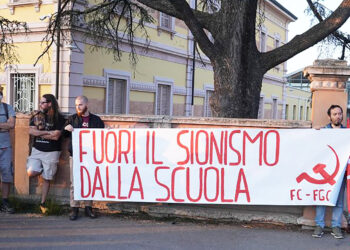
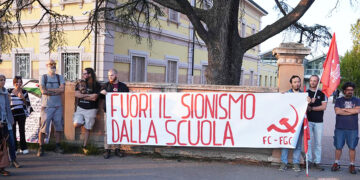
- The Communist Front (FC) and the Communist Youth Front (FGC) reiterate their fraternal support for communist parties in other EU member countries engaged in the European election campaign, starting with the European Communist Action (ECA) parties, comrades from the Communist Party of Greece (KKE), the Communist Workers’ Party of Spain (PCTE) and the Communist Party of Sweden (SKP). An advance by communists in one European country, in the current context, can strengthen the struggle and efforts of communists in all other countries. The example and experience of the international communist movement is a valuable treasure for those who, like us in Italy, are struggling today on the rubble left behind by opportunism.
- We believe the time is ripe for a change of pace, starting with ourselves. It is time to increase our efforts, our joint work, our capacity for initiative and the proactivity necessary to advance a political-organizational path for communist reconstruction in Italy, starting in the coming weeks. All the militant, political and theoretical contribution that we can make and express in the confrontation with comrades throughout Italy, with all national and local organizations, with collectives and individual militants, with the most conscious workers and vanguard elements of the labor and trade union movement, with all those who pose the problem and recognize the need to constitute the current forces into a party, will be directed precisely in this direction from today.
All our energies are today in the service of this cause.
The fire has not gone out.
“There can be no victory, no conquest, without a great communist party.”